On Site
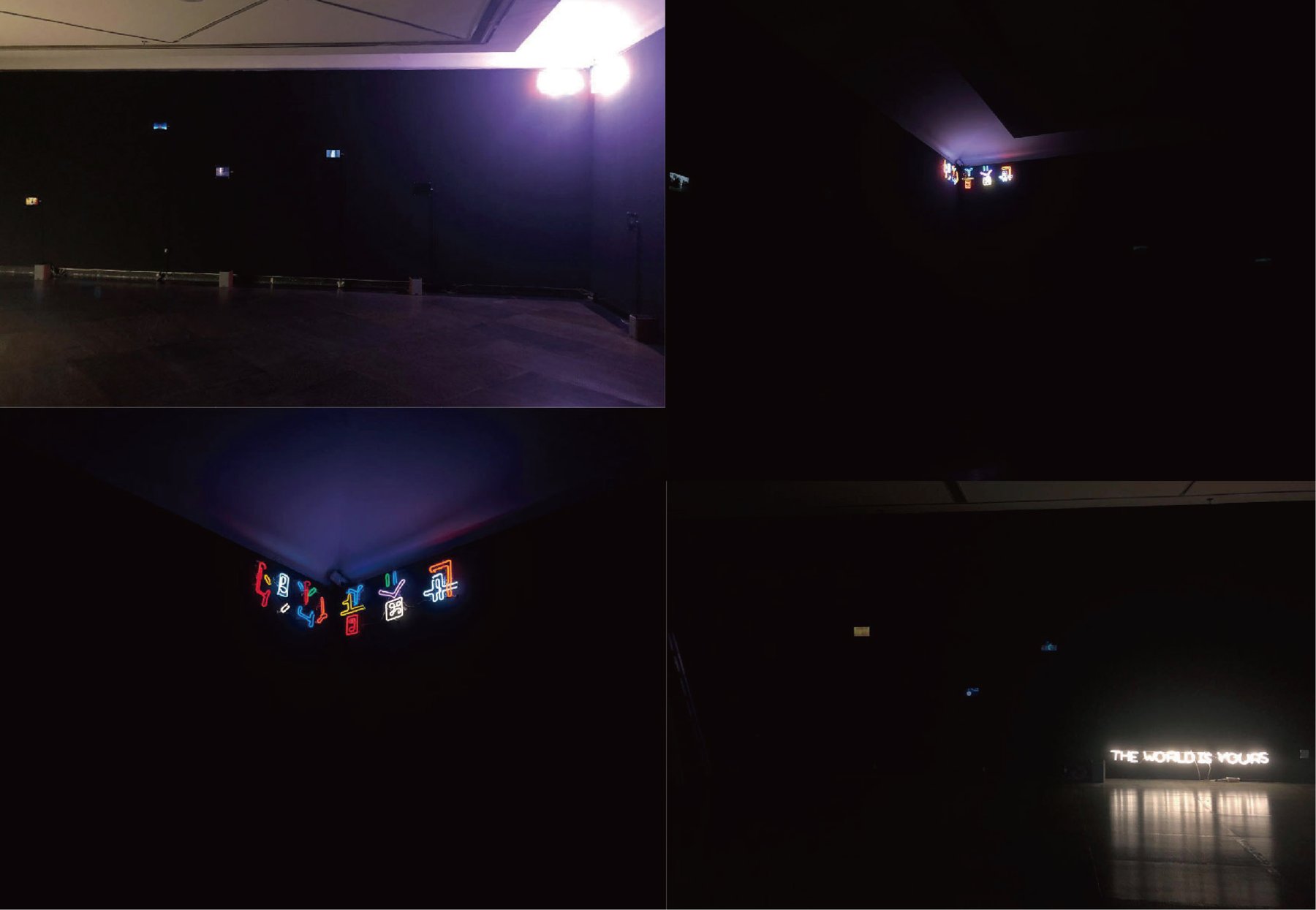
Simulated installation — small screens in a blackout hall; fractured-glyph neon in the corner; the sentence as a white neon resting on the floor.
We live, more than ever, on other people's experience. Reviews, guides, patient stories, podcasts, the advice of AI — personal experience is no longer private memory; it circulates day and night as content, evidence, care, and data. This circulation rests on an assumption we rarely examine: that experience can be spoken, heard, and handed over whole.
Yet understanding always begins from a partial position — no one stands inside another's experience. We know more than we can tell; experience keeps a tacit remainder, and language carries only its surface. Understanding was never a handover. It is an ongoing negotiation: guessing, misreading, repairing — until, at some moment, someone says: I think I understand.
We spent long hours with several blind and low-vision friends, asking them to describe their worlds, and translated those descriptions into moving images. They are not the subject of this work but its most honest case: the same negotiation happens in every act of telling and listening.
The captions beside the films are the translators' second readings — not quotations. Some films combine the descriptions of several storytellers. They record how we listened, not what was said.
Medium: multi-screen digital video, 8-channel sound installation. The sound layer is complete in itself: for blind and low-vision visitors it is the entire work, and the images are its translation into light.
© THE WORLD IS YOURS. All films and recordings remain with their makers.
Eight channels, eight corners of a dark room. The sound never pairs with the screens: to see, you walk to an image; to listen, you stand where the channels balance. The channels carry one sentence — the one this work is named after — spoken nearly two hundred times by different voices, in different accents, and cut into eight channels. One sentence, two hundred ways of saying it.
Combined stereo reference of the eight channels, 11'09". In the room they play as eight independent sources. The only words spoken are the sentence itself — 世界是你的, the world is yours — nearly two hundred times, in different voices and accents. That is the complete transcript; see ACCESS.
Simulated installation — small screens in a blackout hall; fractured-glyph neon in the corner; the sentence as a white neon resting on the floor.
It may be a gift. It may be a trust handed over. It may simply be the version least likely to be misunderstood. We cannot tell which — and this work refuses to decide.
This work was made with blind and low-vision collaborators, and this page is meant to be read with a screen reader as well as with eyes.
The films are silent. Each film carries a written reading — the translators' second reading of a spoken description — available as text in the index and beside each film. The readings are the films' text alternative, not captions of dialogue: there is no dialogue.
The sound layer is complete in itself. The eight channels (11'09") are the entire work for blind and low-vision visitors; the images are their translation into light. Complete transcript: the only words spoken are 世界是你的 — "the world is yours" — spoken nearly two hundred times by different voices and accents, cut into eight channels. What differs is everything writing cannot carry: voice, accent, pace, warmth, hesitation.
Navigation. All films can be opened from the list with Enter; in the viewer, arrow keys change films and Escape returns to the index. Animations are reduced automatically if your system asks for reduced motion.
Interview consent and exhibition-playback consent were collected separately; storytellers keep veto power over the finished films. Blind collaborators are credited, compensated co-creators. If anything on this page is hard to reach with your assistive technology, please tell us — nikkiyao@bu.edu.